

If you try to ban, dispute, or take something away from Serbs, instead of that one thing, you will get two.
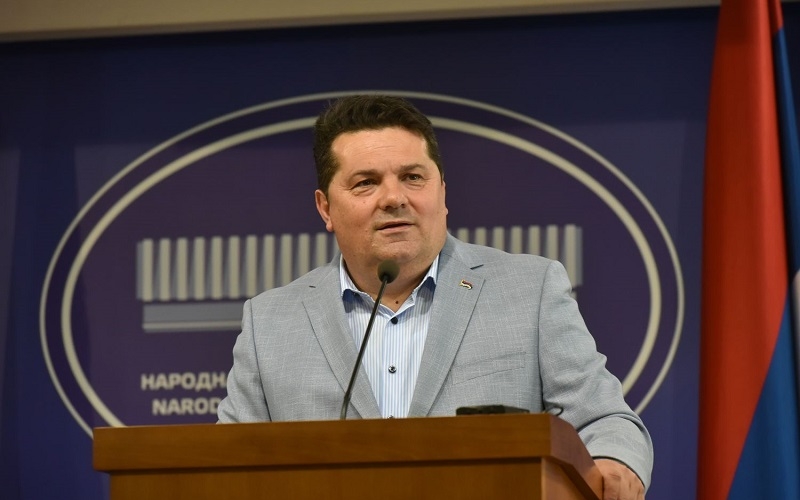
This is the message from the Speaker of the National Assembly of the Republic of Srpska, Dr. Nenad Stevandić, directed at all those who attempt to impose bans or their will upon the Serbian people.
"As we approach the 34th anniversary of the Republic of Srpska, here is an important lesson: It would be best if you didn't try to take anything away from the Serbs, or to abolish or ban anything. Whenever you try that, we turn one into two," Stevandić says in a video posted on social media.
He supported this claim with examples from the past that prove his point.
"They tried to abolish our traditional flag, which is older than all nations and states in the Balkans, and, of course, they failed. We use the flag with the Nemanjić coat of arms in our homes, offices, and on historical and important dates, but alongside it, we now also use the traditional Serbian tricolor flag. If you tried to abolish one, you got two flags," Stevandić says, pointing to both flags in the hall of the National Assembly of Srpska.
He noted that a similar incident occurred with the "sad attempt" to ban the Nemanjić coat of arms, the most sacred emblem in Serbian history, which still adorns the Speaker's office and many others.
"It is a part of our identity before which our ancestors and we have taken oaths for centuries; a coat of arms that guarded all our Slavas and is part of our soul. As you know, they didn't succeed. It is in every Serbian home, and every Serbian child knows what the Nemanjić coat of arms is. In response to all that, we have respected the form and now have the Emblem of the Republic of Srpska as another coat of arms, which also carries all the hallmarks of our statehood, including our crown and flag. The emblem says that we do not renounce what is ours. Instead of one coat of arms, those who wanted to abolish it got two again," Stevandić recalls.
However, Stevandić pointed out that the "greatest madness" was the failed attempt to abolish the birth date of the Republic of Srpska—January 9th.
"They tried to say that we weren't born on that day, but on a day that some 'high' or 'low' [officials], or various Serbophobes and auto-chauvinists, would determine. For so many years, they tried to convince us that we weren't born on January 9th, and that Serbian deputies didn't vote on that day. They failed! It is celebrated in every home; the people decorate with flags, but in addition to that, as is well known, we gained another date to celebrate—Sretenje (Candlemas), February 15th. That is the date of Serbian statehood. That statehood is both Sretenje and Saint Stephen; those are historical facts and are more a matter of emotion, positive, patriotic emotions on our side, and emotions of hatred on the other side, which they want to turn into a political story of bans. Do not ban anything for the Serbs," Stevandić warns once more.
In conclusion, Stevandić sent an open-ended but very clear message to those who dream of abolishing the Republic of Srpska.
"Let them think carefully, because we are a people who know our history, faith, and tradition. If you try to abolish the Republic of Srpska, you might get... well, you know yourselves, instead of one," the Speaker of the National Assembly of Srpska concludes.