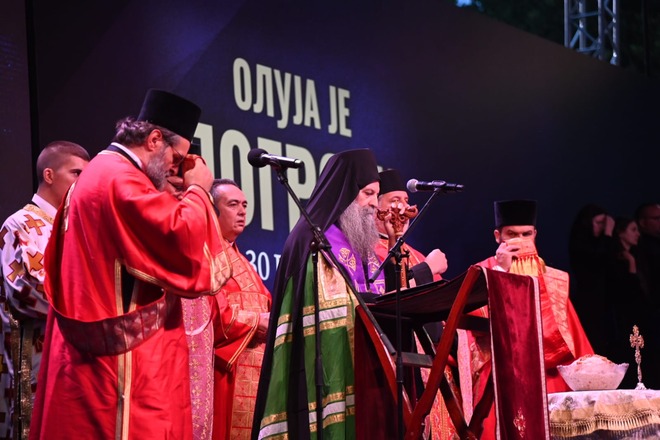

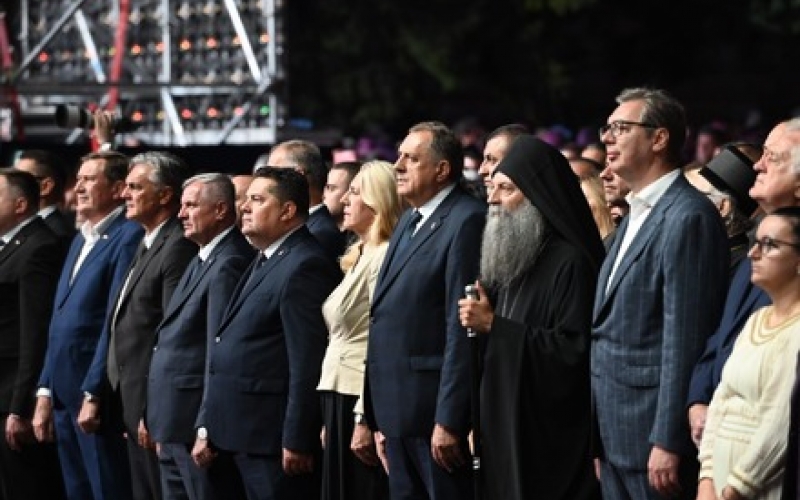
The President of the National Assembly of the Republic of Srpska, Dr. Nenad Stevandic, attended a state ceremony today in Sremski Karlovci to commemorate the Day of Remembrance for all Serbs who were killed and exiled in the military operation "Oluja" (Storm). The event, titled "Oluja is a Pogrom - We Remember Forever," was jointly organized by the Republic of Srpska and Serbia.
The ceremony was also attended by the Presidents of the Republic of Srpska and Serbia, Milorad Dodik and Aleksandar Vucic; the Serb member of the Presidency of Bosnia and Herzegovina, Zeljka Cvijanovic; the President of the National Assembly of Serbia, Ana Brnabic; the Prime Ministers of the Republic of Srpska and Serbia, Radovan Viskovic and Djuro Macut, respectively; ministers from both governments; and numerous citizens.
The memorial service for the victims was led by His Holiness Serbian Patriarch Porfirije, who said on the occasion that "Oluja" united the people in their love for the martyrs.
"In Sremski Karlovci, a witness to our suffering, we are gathered tonight by our love for our martyrs—our relatives, neighbors, and fellow countrymen—who, during the terrible persecution from their ancestral homes in Dalmatia, Lika, Kordun, and Banija in August 1995, lost their innocent lives," Patriarch Porfirije said.
During the commemoration, Serbs from the convoy of refugees from Croatia addressed the crowd, sharing their memories and testimonies of what they experienced during the exodus.
The President of the Republic of Srpska, Milorad Dodik, stated that if the commemoration of this pogrom had not taken place, it would have been repeated. He said that he did not want to forgive the suffering of the Serbs but that the Krajina people who survived this gave strength to the Serb people.
"You who survived the suffering, who are still alive and with us today, you should know—it was close that we bury you alive. If we had not started commemorating the Day of Suffering, it could have happened that you would no longer be spoken of," Dodik said.
He reminded the audience that thousands of people died on that day, and 250,000 Serbs were expelled from Croatia and Krajina.
Serbian President Aleksandar Vucic said that the heart of the Krajina people is big and thanked the people who came to Serbia for the love they gave to Serbia.
"Never have so many of us gathered to commemorate the criminal 'Oluja.' Thank you to all the Krajina people in our Serbia and across the former Yugoslavia. Thank you, Krajina people, who live in Serbia today, for all that you have endured and given to this country. For the love you have given Serbia. The heart of the Krajina people is enormous, and in it—is the most love for Serbia," Vucic emphasized.
He reminded the audience that the people came to Serbia because they had to, but that by coming, they contributed to the progress of Serbia.
The criminal military-police action "Oluja" began on August 4, 1995, with an offensive action by the Croatian army and police and HVO units in the areas of Banija, Lika, Kordun, and northern Dalmatia.
A day later, on August 5, the Croatian army entered the almost deserted Knin and raised the Croatian flag, while columns of refugees moved through Serb territories in Bosnia and Herzegovina toward Serbia.
During "Oluja," more than 220,000 Serbs were expelled, and nearly 2,000 Serbs, mostly civilians, were killed or disappeared. No one has been held accountable for this crime against the Serb people.
In the February 2015 judgment, the International Court of Justice classified "Oluja" as ethnic cleansing.